Unscrambly
UnscrAMBLY is an international research collaboration between labs from Hungary, Romania, Belgium and Norway. UnscrAMBLY stands for: "Understanding brain circuit dysfunction in amblyopia using large-scale multimodal recordings in a new visuomotor task applied to animal models and patients". The project is funded by the ERA-NET NEURON program (2019-2.1.7-ERA-NET-2022-00047).
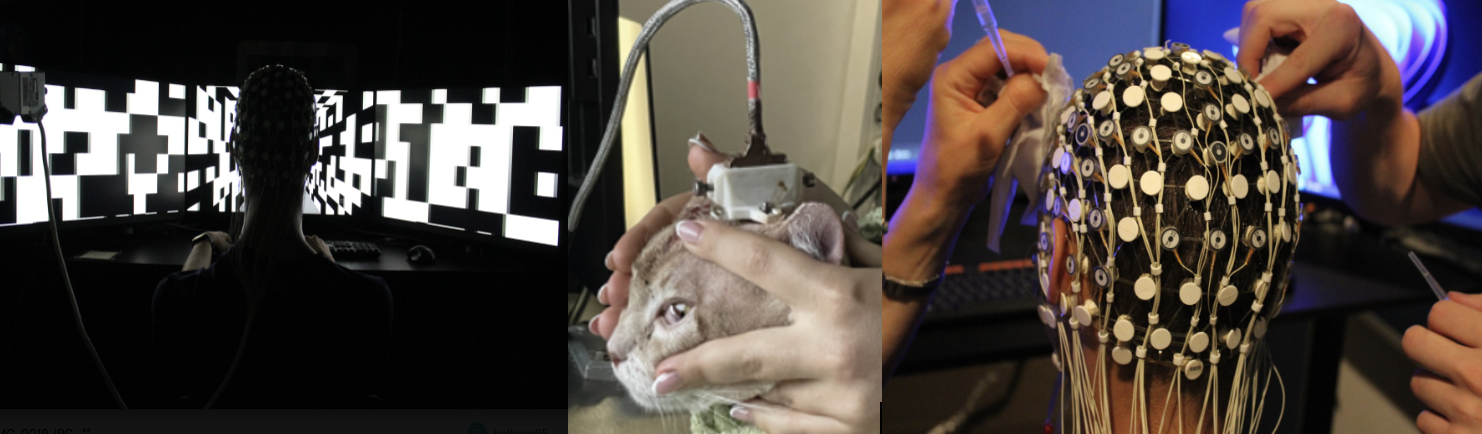
Amblyopia (also known as “lazy eye”) is one of the most studied neurodevelopmental vision disorders. Amblyopia must be diagnosed early and treated promptly because current treatments cannot help recovering lost vision beyond the age of 8 years. Even treated amblyopic patients often have permanently decreased performance in everyday tasks including reading, driving or walking. By 2040 the vision of 200 million patients will be compromised by amblyopia motivating us to develop a new, efficient and widely accessible test for diagnosis and treatment monitoring. Our study aims to exploit the capacity of the brain to predict expected changes in the visual scene, especially those caused by our own motion. Subjects will pedal on a home-trainer bike in a virtual reality corridor while brain activity, eye- and limb motion is recorded. We briefly halt the visual motion at small regions of the scene and analyze brain activity, eye- and limb-motion data. Using machine learning we determine differences between healthy and amblyopic subjects. In humans we use noninvasive recording that captures brain surface activity. Magnetic resonance imaging could also record deep brain activity but requires a fixed body and head for prolonged times thus is not applicable to our study. To collect high-resolution data also from deep regions of the brain we use cats and mice as amblyopia models. Visual function of the cat is very similar to humans. We use functional ultrasound imaging in behaving cats to link activity of deep brain areas to amblyopia. Genetic tools available in mice allow us to test the functional role of brain regions involved in amblyopia in even more detail. This combined method will help us to provide a very robust network view of the origins of amblyopia and serve as a first step to set new and better directions for therapy. Our new method and the expected results may generalize to other neurodevelopmental disorders providing a widely applicable tool for clinical diagnosis and basic research.
Partners
HUN-REN TTK, Budapest, HungaryTINS, Cluj-Napoca, Romania
KU Leuven, Leuven, Belgium
SOTE, Budapest, Hungary
University of Oslo, Oslo, Norway
Key project activities
24.04.2022 Radio report of our ERA-NET Neuron project (HU) – Interview with Daniel Hillier about our research project on amblyopia. CIVIL RADIO
02-04.11.2023 TINS visiting TTK, building up the bike-tunnel setup in the EEG lab (TTK)
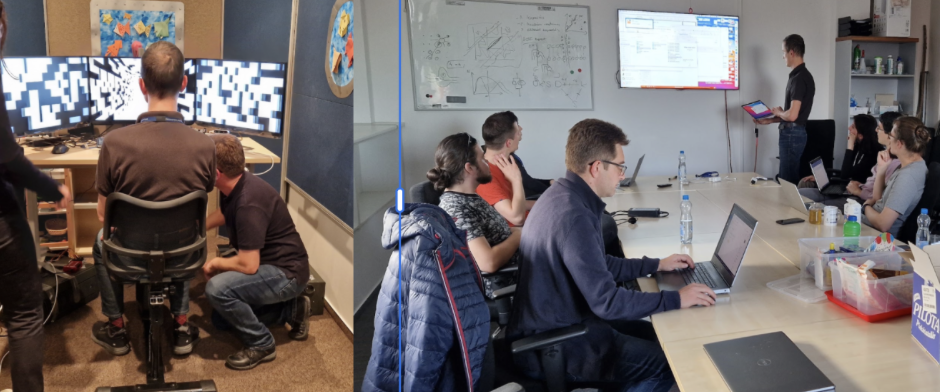
06.12.2023 TTK visiting the Semmelweis University, Ophthalmology, presenting the project with a short film, recruiting clinicians
24-26.01.2024 MITT Conference, Pécs, presenting and networking, coming into contact with Dr. Gabor Jandó (University of Pécs) and his research group. Collaborating with the Jandó group and sharing the Euvision vision application developed by them.
Publications
Domonkos Horváth, Klaudia Csikós, Ábel Petik, Botond Roska, Daniel Hillier "An optimized anesthesia protocol for longitudinally reproducible functional ultrasound imaging in the cat visual cortex", 2026 manuscript
D. A. Dumitru, E. B. Ceuta, V. V. Moca, R. C. Mureșan and M. Dînșoreanu, "Extraction of Functional Brain Networks from EEG Signals in the Context of Visual Perception," 2022 IEEE International Conference on Automation, Quality and Testing, Robotics (AQTR), Cluj-Napoca, Romania, 2022, pp. 1-6, https://doi:10.1109/AQTR55203.2022.9801941
Bârzan H, Ichim A-M, Moca VV and Mureșan RC, "Time-Frequency Representations of Brain Oscillations: Which One Is Better?" Frontiers in Neuroinformatics, 2022, Vol. 16:871904, https://doi.org/10.3389/fninf.2022.871904
George F. Grosu, Alexander V. Hopp, Vasile V. Moca, Harald Bârzan, Andrei Ciuparu, Maria Ercsey-Ravasz, Mathias Winkel, Helmut Linde, Raul C. Mureșan, "The fractal brain: scale-invariance in structure and dynamics," Cerebral Cortex, 2022, bhac363, https://doi.org/10.1093/cercor/bhac363